- 1st floor, Parshwanath Residency, Shukrawar Peth, Opp. Kumar Prestige Point, Bajirao Road, Pune.
6, Triveni Apartment, 1st Floor, Near Santosh Hall, Anandnagar, Sinhagad Road, Pune.
x

Dr. Bhange Eye Hospital, Bajirao Road, Pune.
Samarth Eye Clinic, Sinhgad Road, Pune
LASIK Eye Surgery in Pune | Dr. Bhange Eye Hospital
- Home
- LASIK Eye Surgery In Pune
- All Treatment
- Cataract Surgery
- Common Eye Problems
- Corneal Diseases and Disorders
- Diabetic Eye Disease
- Dry Eye Syndrome
- Eyelid Diseases and Disorders
- Glaucoma Treatment and Surgery
- Macular Diseases and Disorders
- Neurological Eye Diseases and Disorders
- Retinal Diseases and Disorders
- Uveitis and Iritis
- Squint Treatment
- Oculoplasty Surgery
- Lacrimal Disorders
LASIK Eye Surgery in Pune
LASIK Eye Surgery at Dr. Bhange Eye Hospital (Shukrawar Peth) & Samarth Eye Clinic (Sinhagad Road), Pune
LASIK (Laser-Assisted In Situ Keratomileusis) is one of the most widely performed laser vision correction procedures for reducing dependence on spectacles and contact lenses. By reshaping the cornea with advanced laser technology, LASIK helps correct common refractive errors such as myopia (nearsightedness), hyperopia (farsightedness), and astigmatism, allowing light to focus accurately on the retina for clearer vision.
At Dr. Bhange Eye Hospital, Shukrawar Peth (Bajirao Road), and Samarth Eye Clinic, Anandnagar, Sinhagad Road, we provide comprehensive LASIK evaluations using advanced diagnostic technology to determine whether laser vision correction is suitable for your eyes. With 35+ years of trusted eye care in Pune, our experienced ophthalmologists offer personalized, evidence-based treatment plans designed to help patients achieve safe, effective, and long-lasting visual improvement.
Whether you are looking to reduce dependence on glasses, stop wearing contact lenses, or explore modern vision correction options, our team is committed to helping you make an informed decision based on your individual eye health and lifestyle.
What is LASIK Eye Surgery?
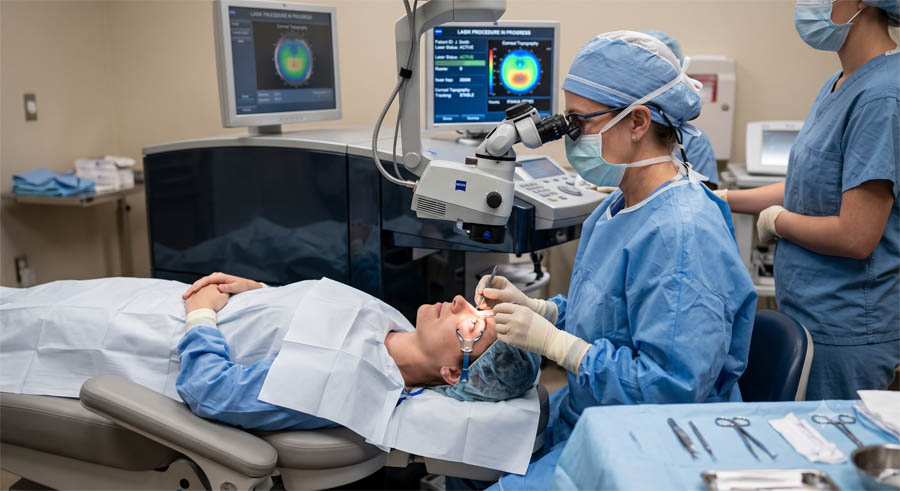
LASIK (Laser-Assisted In Situ Keratomileusis) is an advanced refractive surgery that uses laser technology to reshape the cornea, improving the way light is focused onto the retina. This helps correct refractive errors and provides clearer vision without relying heavily on spectacles or contact lenses.The procedure is performed using precise laser technology and is generally completed within a short period. Most patients experience noticeable visual improvement within the first few days after surgery.
Conditions Corrected by LASIK
LASIK surgery may be recommended to correct:
Myopia (Nearsightedness)
Difficulty seeing distant objects clearly while nearby objects remain in focus.
Hyperopia (Farsightedness)
Difficulty focusing on nearby objects, and in some cases distant vision may also be affected.
Astigmatism
Blurred or distorted vision caused by an irregularly shaped cornea.
Benefits of LASIK Eye Surgery
LASIK offers several advantages for appropriately selected patients:
- Reduced dependence on spectacles and contact lenses
- Rapid visual recovery
- Precise laser-based treatment
- Minimal discomfort during the procedure
- Short procedure time
- Improved quality of life
- Long-term vision correction for suitable candidates
- High patient satisfaction
- Quick return to routine activities
Symptoms That May Indicate You Need Vision Correction
You may benefit from a LASIK consultation if you:
- Frequently depend on spectacles
- Experience contact lens discomfort
- Have stable spectacle power
- Wish to reduce dependence on corrective eyewear
- Have difficulty during sports or outdoor activities because of glasses
- Prefer greater visual freedom in daily life
Comprehensive LASIK Evaluation
Before recommending LASIK, our ophthalmologists perform a detailed assessment that may include:
- Comprehensive eye examination
- Refraction test
- Corneal Topography
- Corneal Thickness Measurement (Pachymetry)
- Wavefront Analysis (when indicated)
- Tear Film Assessment
- Pupil Size Evaluation
- Intraocular Pressure Measurement
- Dilated Retinal Examination
These investigations help determine whether LASIK is safe and suitable for your eyes while supporting personalized treatment planning.
Types of LASIK Procedures
Depending on your eye condition and clinical evaluation, different laser vision correction techniques may be considered, including:
- Conventional LASIK
- Blade-Free (Femto) LASIK
- Wavefront-Guided LASIK
- Topography-Guided LASIK (Contoura Vision)
- Customized LASIK (where clinically appropriate)
Your ophthalmologist will recommend the most appropriate procedure based on your eye health, refractive error, and visual requirements.
Advanced LASIK Eye Surgery in Pune
At Dr. Bhange Eye Hospital, Shukrawar Peth (Bajirao Road), and Samarth Eye Clinic, Anandnagar, Sinhagad Road, we provide comprehensive LASIK evaluation and personalized treatment planning for individuals seeking long-term vision correction. Every patient undergoes a detailed eye examination to determine whether LASIK is the most suitable procedure based on their refractive error, corneal health, lifestyle, and visual needs.
Our goal is to help patients achieve clearer vision with safe, evidence-based laser vision correction supported by advanced diagnostic technology and experienced ophthalmic care.
How Does LASIK Eye Surgery Work?
LASIK (Laser-Assisted In Situ Keratomileusis) corrects refractive errors by reshaping the cornea using a highly precise laser. When the cornea is properly reshaped, light focuses accurately on the retina, resulting in clearer vision and reduced dependence on spectacles or contact lenses.
The procedure is performed using advanced laser technology and is completed within a short time. Since only the cornea is reshaped, no artificial lens is implanted inside the eye.
Advanced Technology for LASIK Evaluation
Successful LASIK surgery begins with accurate diagnostic testing.
At Dr. Bhange Eye Hospital and Samarth Eye Clinic, comprehensive evaluation may include:
Corneal Topography
Maps the shape and curvature of the cornea to identify irregularities and determine suitability for LASIK.
Pachymetry
Measures corneal thickness, an essential factor in planning safe laser treatment.
Wavefront Analysis
Evaluates higher-order optical aberrations to help customize treatment for improved visual quality in selected patients.
Tear Film Assessment
Assesses the health of the tear film to identify dry eye disease before surgery.
Pupil Size Evaluation
Measures pupil size under different lighting conditions to assist in treatment planning.
Dilated Retinal Examination
Examines the retina to detect retinal conditions that may require treatment before LASIK.
LASIK vs ICL – Which Vision Correction Procedure is Right for You?
Both LASIK and ICL surgery are effective methods of correcting refractive errors. The most appropriate option depends on your eye structure and clinical evaluation.
| Feature | LASIK | ICL Surgery |
|---|---|---|
| Cornea Reshaped | Yes | No |
| Artificial Lens | No | Yes |
| Suitable for Thin Corneas | Not Always | Yes |
| Reversible | No | Yes |
| Recovery | Quick | Quick |
| Best For | Mild to Moderate Refractive Errors | Moderate to High Refractive Errors |
A detailed eye examination helps determine which treatment is most appropriate for your eyes.
Is LASIK Eye Surgery Safe?
LASIK is a well-established vision correction procedure that has helped millions of people worldwide reduce their dependence on spectacles and contact lenses. For appropriately selected patients, it has a high success rate and a well-documented safety profile.
At Dr. Bhange Eye Hospital and Samarth Eye Clinic, every patient undergoes a thorough preoperative evaluation to ensure that LASIK is suitable and that treatment recommendations are based on individual eye health and evidence-based clinical guidelines.
Possible Risks and Complications
Like any surgical procedure, LASIK carries potential risks, although serious complications are uncommon.
Possible risks include:
- Temporary dry eyes
- Glare or halos around lights
- Light sensitivity
- Under-correction or over-correction
- Temporary fluctuations in vision
- Infection (rare)
- Corneal flap-related complications (uncommon)
- Need for enhancement treatment in selected cases
Our ophthalmologists explain the expected benefits, possible risks, and postoperative care in detail before surgery so patients can make informed decisions.
Recovery After LASIK Eye Surgery
Most patients notice significant improvement in vision within 24 to 48 hours, although complete visual stabilization may take several weeks.
To support healing, patients should:
- Use prescribed eye drops as directed.
- Avoid rubbing the eyes.
- Wear protective eye shields while sleeping during the initial recovery period if advised.
- Avoid swimming and dusty environments for a short period.
- Limit strenuous physical activities as recommended.
- Attend all scheduled follow-up appointments.
Following postoperative instructions carefully helps promote optimal healing and long-term visual outcomes.
Why Choose Dr. Bhange Eye Hospital & Samarth Eye Clinic for LASIK Eye Surgery in Pune?
Choosing the right ophthalmology team is one of the most important decisions when considering laser vision correction.
Patients trust Dr. Bhange Eye Hospital, Shukrawar Peth (Bajirao Road), and Samarth Eye Clinic, Anandnagar, Sinhagad Road, because we combine advanced diagnostic technology, personalized treatment planning, and ethical ophthalmic care.
Our Strengths
- 35+ Years of Trusted Eye Care in Pune
- Experienced ophthalmologists
- Comprehensive LASIK evaluation
- Advanced diagnostic technology
- Personalized treatment planning
- Ethical and evidence-based care
- Modern ophthalmic infrastructure
- Patient-centered approach
- Long-term postoperative follow-up
- Convenient locations in Shukrawar Peth and Sinhagad Road
Living After LASIK Surgery
Many patients experience greater visual freedom following LASIK surgery and can comfortably return to work, sports, driving, and daily activities after the recommended recovery period.
Regular eye examinations remain important even after successful LASIK to monitor overall eye health and maintain long-term vision.
Who Should Consider LASIK Eye Surgery?
LASIK eye surgery is an excellent option for individuals who want to reduce their dependence on glasses or contact lenses and enjoy clearer vision in their daily lives.
You may be a suitable candidate if you:
- Are 18 years of age or older
- Have a stable spectacle power for at least one year
- Have healthy eyes and adequate corneal thickness
- Have myopia (nearsightedness), hyperopia (farsightedness), or astigmatism within treatable limits
- Are looking for long-term vision correction
- Wish to reduce or eliminate the need for spectacles or contact lenses
A comprehensive eye examination is essential to determine whether LASIK is the most appropriate treatment for your eyes.
Can LASIK Eye Surgery Be Repeated?
Some patients may benefit from an enhancement procedure if vision changes over time or if additional correction is clinically appropriate. Whether a repeat LASIK procedure is suitable depends on factors such as corneal thickness, eye health, and the amount of residual refractive error.
A detailed evaluation by an experienced ophthalmologist is necessary before considering enhancement surgery.
Frequently Ask Questions
-
What is LASIK eye surgery?
LASIK is a laser vision correction procedure that reshapes the cornea to correct refractive errors such as myopia, hyperopia, and astigmatism, helping reduce dependence on glasses or contact lenses.
-
Is LASIK surgery permanent?
LASIK permanently reshapes the cornea to correct the existing refractive error. However, natural age-related vision changes may still occur over time.
-
Is LASIK painful?
No. The procedure is performed under local anaesthetic eye drops, and most patients experience minimal discomfort.
-
How long does LASIK surgery take?
The procedure usually takes about 15 to 20 minutes for both eyes, although the laser treatment itself lasts only a few seconds per eye.
-
When can I return to work?
Many patients return to work within one to three days, depending on their recovery and their ophthalmologist's advice.
-
Can both eyes be treated on the same day?
Yes. In most cases, both eyes are treated during the same LASIK session.
-
Is LASIK safe?
LASIK is a widely performed and well-established procedure. Careful patient selection and detailed preoperative evaluation contribute to successful outcomes.
-
Will I still need glasses after LASIK?
Many patients achieve excellent vision with significantly reduced dependence on glasses or contact lenses. Individual outcomes may vary.
-
Can LASIK correct high spectacle power?
LASIK can correct many refractive errors, but patients with very high spectacle power or thin corneas may benefit from alternatives such as ICL surgery.
-
Can LASIK treat astigmatism?
Yes. LASIK can effectively correct many cases of astigmatism following a detailed eye evaluation.
-
Can I use my mobile phone after LASIK?
Your ophthalmologist may recommend limiting screen time for the first 24 hours. Thereafter, you can gradually resume normal use while following postoperative instructions.
-
Can I play sports after LASIK?
Most patients can return to sports after the recommended healing period. Your ophthalmologist will advise when it is safe based on your recovery.
-
How soon can I return to normal activities?
Many patients resume routine activities within one to three days, depending on their recovery and their ophthalmologist's advice.
-
Can LASIK remove spectacle power permanently?
LASIK permanently corrects the refractive error present at the time of surgery. However, natural age-related vision changes may still occur later in life.
-
Is LASIK better than ICL surgery?
The answer depends on your eye condition. LASIK is suitable for many patients with adequate corneal thickness, while ICL surgery may be a better option for individuals with thin corneas or higher refractive errors.
-
Where can I undergo LASIK eye surgery in Pune?
Dr. Bhange Eye Hospital, Shukrawar Peth (Bajirao Road), and Samarth Eye Clinic, Anandnagar, Sinhagad Road, provide comprehensive LASIK evaluations and personalized laser vision correction using advanced diagnostic technology and evidence-based ophthalmic care.
Book a Consultation for LASIK Eye Surgery in Pune
If you are considering LASIK to reduce your dependence on glasses or contact lenses, a comprehensive eye examination is the first step toward determining the most suitable vision correction option.
At Dr. Bhange Eye Hospital, Shukrawar Peth (Bajirao Road), and Samarth Eye Clinic, Anandnagar, Sinhagad Road, our experienced ophthalmologists provide detailed evaluations, personalized treatment plans, and advanced laser vision correction using modern diagnostic technology and evidence-based clinical practices.
Schedule your consultation today to explore safe, effective, and personalized LASIK eye surgery in Pune.
Is your vision affecting daily life? Don’t delay treatment.
Even minor eye symptoms can worsen over time if left untreated. Consult our experienced eye specialists early for safe, effective, and personalized eye care. Visit Samartha Eye Clinic Sinhagad Road or Dr Bhange eye hospital in Shukrawar Peth Pune for timely diagnosis and expert ophthalmology treatment.
Contact Now: +91 9822146567 / +91 9422365690
Dr. Bhange Eye Hospital
- 1 st floor, Parshwanath Residency, 1333, Shukrawar Peth, Opp. Kumar Prestige Point, Bajirao Road, Pune
- +91 20 24470284
- +91 9422365690
Samarth Eye Clinic
- 6, Triveni Apartment, 1st Floor, Near Santosh Hall, Anandnagar, Sinhagad Road, Pune – 411 051
- +91 20 24358283
- +91 9822146567
Diabetic Retinopathy Treatment in Pune | Glaucoma Treatment in Pune | ICL Surgery In Pune | LASIK Eye Surgery In Pune | Affordable Cataract Surgery in Pune | Squint Eye Treatment in Pune | Vitreo Retinal Treatment In Pune | Phacoemulsification Cataract Surgery in Pune | Eye Specialist in Sinhgad Road Pune | Eye Clinic Near Me | Oculoplasty Surgeon in Pune | Oculoplasty Surgeon Near Me
Dr. Bhange Eye Hospital © 2026 All Right Reserved. Designed & Developed by Clarosys Technologies.